Showing posts with label ARINDAM CHAUDHURI. Show all posts

Monday, January 14, 2013

India today stands amongst the league of nations which experienced a robust growth in the last decade, but the demand for quality education remains high as ever. Despite increased spending, education with a purpose has been a long-missing ingredient. During Indo-Global Education Summit 2012, the Andhra Pradesh government indicated to bring in radical changes to the higher education system to give education a well-deserved purpose. The government also maintained that the higher education in the state would focus on skill development and improving employment chances of graduates by facilitating collaborations with foreign universities, rather than focusing on the grade, marks education regime.

India has made a huge progress in primary education and expanding literacy rate, but faces stern challenges in higher education. A recent study on ‘Present Performance and Public Expenditure of Higher, Secondary, Primary and Women Education in India’ states that despite all efforts over 25 per cent of the population is still illiterate; only 15 per cent of Indian students reach high school, and just 7 per cent graduate. The quality of education, whether at primary or higher level, is significantly poor as compared with major developing nations. As of 2008, 25 per cent of teaching positions nationwide were vacant and 57 per cent of college professors lacked either a master’s or PhD degree. Click here to read more...

Read More IIPM Related Articles
Zee Business Best B-School Survey 2012
Prof. Arindam Chaudhuri's Session at IMA Indore
IIPM IN FINANCIAL TIMES, UK. FEATURE OF THE WEEK
IIPM strong hold on Placement : 10000 Students Placed in last 5 year
IIPM's Management Consulting Arm-Planman Consulting
Professor Arindam Chaudhuri - A Man For The Society....
IIPM: Indian Institute of Planning and Management
IIPM makes business education truly global
Management Guru Arindam Chaudhuri
Rajita Chaudhuri-The New Age Woman
IIPM B-School Facebook Page
IIPM Global Exposure
IIPM Best B School India
IIPM B-School Detail
IIPM Links
IIPM : The B-School with a Human Face

Friday, October 12, 2012

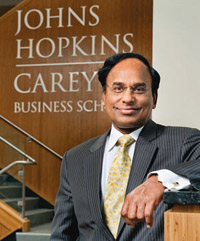
Indranil Das talks to Professor Yash Gupta, Inaugural Dean of Johns Hopkins University, Carey Business School, Regarding The Changing Academic trends in B-Schools in The US

Q: Why is it happening only with the Indians, why don’t we see people from other countries such as China accomplishing the same, as they too stepped into academics when India did?
A: Well, that is correct. A large Chinese population has been residing in the US for generations but the problem is of language. The language barrier is a huge problem when it comes to leadership roles. Secondly, I think many Chinese want to go back home as there are better opportunities in their country. Perhaps, Indians do the exact opposite because leadership opportunities in Indian academia are less.  

Q: You have been a big champion of diversity in all spheres and business too. Any particular reason you see that diversity is important?

A: Diversity is a fundamental thing for any society, never mind the US because what it provides you with is an opportunity to learn from different perspectives. Last century what we saw was a specialisation of one kind. This century is different. You need a different kind of skill set for more creative solutions. When you look at America, the competitive advantage is of technology and we hold a monopoly on the same. Whereas, India’s competitive advantage is that it follows suit with the development of software et al. In short, there are three things which diversity teaches us: the ability to understand and adapt, two it gives you better understanding of global problems, third, it really prepares you for uncertainty in the market. Click here to Continue...

Read More IIPM Related Articles
Zee Business Best B-School Survey 2012
Prof. Arindam Chaudhuri's Session at IMA Indore
IIPM IN FINANCIAL TIMES, UK. FEATURE OF THE WEEK
IIPM strong hold on Placement : 10000 Students Placed in last 5 year
IIPM's Management Consulting Arm-Planman Consulting
Professor Arindam Chaudhuri - A Man For The Society....
IIPM: Indian Institute of Planning and Management
IIPM makes business education truly global
Management Guru Arindam Chaudhuri
Rajita Chaudhuri-The New Age Woman
IIPM B-School Facebook Page
IIPM Global Exposure
IIPM Best B School India
IIPM B-School Detail
IIPM Links
IIPM : The B-School with a Human Face

Wednesday, May 06, 2009

Luxury’s not a lipstick


IIPM - Admission Procedure

Small wonder that there has been a slash in the colossal promotional activities of such luxury brands in recent times. Market watchers claim that Chanel’s couture show (2008 fall-winter collection) was a much muted version of the spectacular displays in previous years. Even the Swiss luxury giant Richemont (owner of prestige brands like Cartier & Montblanc) is cutting down on promotional costs. Given the dramatic dip in their third quarter sales (by 12%) and their quagmire is understandable.

But why has premium-luxury escaped the wrath of the market downturn? Take Tag Heuer. Despite Swiss watch brands seeing an overall drop in export figures, Tag Heuer (from Louis Vuitton), claims that in the last half of 2008, it has grown by nearly 4%. “Recession hasn’t affected us much because we are into the premium luxury segment. Our target audience will buy a Tag Heuer irrespective of recession,” Jean Christophe Babin, President, Tag Heuer told 4Ps B&M.

Clearly, premium luxury and their Richie Rich target audience continue to ride the downturn unaffected. Self-proclaimed global leader in luxury Moet Hennessy Louis Vuitton (LVMH) has recorded 6% growth for the quarter ended December 2008 and Dior has shown a 3% growth in the same period. A glaring case in point is Van Cleef & Arpels (a premium-luxury brand from Richemont) that has shown 5% growth this quarter; while Cartier and Montblanc (mass-luxury brands from the same Richemont Group) recorded negative growth. Here’s what Stanislas De Quercize, President and CEO, Van Cleef & Arpels told this magazine. “We don’t believe in volume growth. The brand has always been into quality sales (as opposed to quantity sales) so our sales figure has remained intact even during recessions.”

What also keeps the premium-luxury flame burning is exposure to emerging markets (instead of depending only on US and European markets). Take for example Cartier. The brand still does not have a direct retail presence in India, whereas LVMH has expanded its arms deeply into Japan, India and China. The company claims that 94% of 20-plus Japanese women own a LVMH bag. That’s huge, given that Japan accounts for almost 41% of the global luxury mart. “This takes care of avoiding the monetary transaction cost, which has been affected due to recession,” feels Bradely Jones, Head of South Asia Unit of UK Trade & Investment. The Lipstick-Index may or may not be decisive in its feelings and judgements; but hey, it does seem that there are a few recession-proof things in this close-knit, global world! Do we hear cheers going up from the likes of Tag Heuer, Versace, Dolce&Gabbana, Van-Cleef & Arpels???

For more articles, Click on IIPM Article.

Source : IIPM Editorial, 2009

An Initiative of IIPM, Malay Chaudhuri and Arindam chaudhuri (Renowned Management Guru and Economist).

For More IIPM Info, Visit below mentioned IIPM articles.
1500-plus IIPM students placed across the country with 44 bagging international offers
IIPM set to beat economic slowdown
IIPM Admission Detail
IIPM Programme :- SUPERIOR COURSE CONTENTS
IIPM INTERNATIONAL - NEW DELHI, GURGAON & NOIDA
IIPM, GURGAON
IIPM : EXECUTIVE EDUCATION
Why Study Abroad When IIPM Gives You 3 global Advantages!


Thursday, November 06, 2008

ARGENTINA: BOND BUYBACK

Though the Argentinean government is already into its third week of a debt buyback programme (has bought back $430 million worth of its 2008 and 2009 bonds) to bolster investor confidence, but it hasn’t been of much help. “Bond buyback by government has boosted some investors’ confidence. But still a lot more needs to be done to restore Argentina’s lost credibility,” P. B. Henry, Professor at Stanford University and an expert of Argentinean issues tells B&E. Certainly at 50% (an estimated $140 billion) of GDP (market exchange rate), Argentina’s public debt is still large. In fact, this is only a bit lower than the level (53%) immediately before the 2001 mayhem which had seen the economy shrivel by 15%, unemployment rate mount to 21% and poverty engulf 56% of Argentines. Moreover, the current estimate also does not include $23.5 billion in debt held by the holdouts (those who refused to accept the terms of the 2005 restructuring). If this is included, the ratio is surely over 60% of GDP.....Continue

Source : IIPM Editorial, 2008
An Initiative of IIPM, Malay Chaudhuri and Arindam chaudhuri (Renowned Management Guru and Economist).

Read also :-

Friday, October 03, 2008

Yes, Dr. Singh! It’s a huge crisis that looms in front of us; yet, it’s an excellent opportunity to display great leadership and become a statesman!

It seemsProf. Arindam Chaudhrui that the ruling United Progressive Alliance (UPA) is all set to gift away a comfortable victory for the Bharatiya Janata Party and its allies in the forthcoming Union elections, with the latter doing nothing much to earn it. Looking at the way things are happening, it is as if history is repeating itself. It was not very long ago that onions had taken away the sheen of whatever good work that the then National Democratic Alliance had done. The electorate had then ruthlessly stripped them of their power, showcasing the crude fact that the Indian electorate posses extremely short memories, particularly when it comes to elections. And this time, no one else is realising it more than the ruling UPA. They realise that gone is the euphoria they created by gifting the huge Rs.60,000 crore loan waiver for farmers in this year’s annual budget, and that too barely two months ago. And gone along with it is the positive sentiment that was created by the increase in the non-taxable income from Rs.1 lakh to Rs.1.5 lakh. Also gone is the populist Sixth Pay Commission, which was clearly to woo the Indian middle class.

In less than a few weeks’ time, all that the UPA (and not just the Congress) had tried to prove – as being the representative of the aam aadmi – has been withered away by a phenomenon that is taking catastrophic proportions not just within the nation, but globally. The inflation figure, which is hovering at around 7.33%, has been giving sleepless nights to most governments across the world, including the UPA. In fact, UPA should remember quite well how, around a decade back, BJP had to pay dearly by getting routed in three state assembly elections, simply because the prices of onions had skyrocketed. And this time, it is not just onions; prices have shot up across each and every basic commodity, making things extremely difficult for the Congress. And out of nowhere, a disorganised opposition led by BJP, has found a major poll plank to avenge its earlier defeat. And if the UPA fails to reign in the prices, then it is needless to state that it would all be over for them, at least in the forthcoming elections......Continue


Signature of Prof. Arindam Chaudhuri


Source : IIPM Editorial, 2008
An Initiative of IIPM, Malay Chaudhuri and Arindam chaudhuri (Renowned Management Guru and Economist).

Read also :-

Saturday, September 27, 2008

Right hair, right now

Finally, a fairytale ending for a timeless ‘hairytale’ ?!
Barring phallus and breast size, nothing in the history of mankind has interested, mystified, intrigued and puzzled humans about personal appearance more than human hair… or the lack of it. Annals have pointed to some bizarre and weird methods to hide male and female baldness. Chinese used to wear Nawaz Sharifhorses’ tails on their heads. Greeks would eat hair to get hair. Some tribes also believed that washing hair with certain animal’s blood would revitalise their thinning hair. Then came the wigs, which were almost patronised by Queen Elizabeth I in 1600s in her court with her legendary red and curly wig. Since then, till early 20th century, almost all men and women of prestige and power customarily wore wigs in the English and the French courts.

And in our times, came the resurrection in the form of hair weaving and hair transplant. Though on the pricy side, it did provide means by which harrowed people could conceal their receding hairlines. However, it was a curative measure rather than preventive.Continue....
Source : IIPM Editorial, 2008
Read also :-

Tuesday, September 23, 2008

Curbing inflation

Curbing inflation seems to be the major concern for RBI. But is the over emphasis on inflation hurting growth? Yes and no! Inflation, which is an iniquitous tax, hurts the poor more than the rich, and must be undoubtedly contained. To that effect, the banking industry seems to have paid heed to RBI Governor Y.V. Reddy’s suggestion (or was it an order?) that “net interest margin of banks was high and there was scope for reducing lending rates.” Considering the fact that non-food credit off-take has come down in the recent past, large banks like SBI, HDFC and ICICI decided to bring down the rates. Thanks to the ‘peer fear’, other banks are falling in line. Increasing credit flow to small scale and medium enterprises, and providing a boost to the housing sector as well as to other productive sectors are amongst the few cited positive effects of the rate slash. But in reality, have banks bent down because of a political diktat from the finance ministry?

Dr. Mukesh Kumar Anand (Senior Economist, National Institute of Public Finance and Policy) rules out the logic, and says “The finance ministry does not interfere with the banks in deciding their rates; the finance minister and the RBI governor merely asked them to consider a reduction in rates in order to boost growth.” But sir, that’s not what many banks are telling us. In fact, the smaller banks are waiting for a deeper rate cut, before following suit. Given the situation, bankers with a good quality portfolio and improved operational efficiency would benefit the most. And the rest will need to shape up. According to Ritesh Maheshwari (Senior Director, Financial Institutions Rating, Standard & Poors), “In 2008, the Indian banking system will continue to reap benefits of a strong domestic growth.” It is expected that prudent monetary policy changes will help bring about the benefit of anchoring inflation expectations. With inflation rate under control, interest rates could come down by 25 basis points or so, or remain stable.

Tied in exchange knots

On a visit to Tirupur, which is around an 80 minute drive from Coimbatore airport, there’s hardly anything that would strike you as particularly spectacular, barring the larger-than-life banners of AIADMK chief Jayalalitha and her party leaders. Even the locals grudgingly admit that there is not one tourist attraction to boast off, and if it were not for the giant strides made as an export hub for knitwear, Tirupur would have had a very slim chance of moving out of obscurity. But move out it did, and how, thanks to Verona, an Italian merchant who recognised the potential and brought in a deluge of business opportunities for these hardworking, entrepreneurial people, mainly from Europe & America. Indeed, the story of Tirupur is, in many ways, a story of the Indian resurgence in manufacturing and exports. Local exporters have been servicing many high-profile international apparel brands like Nike, Adidas, Arrow, Tommy Hilfiger, and departmental chains like Wal-Mart, Target, Sears and Mother Care. In 2006-07, Tirupur’s turnover was a whopping Rs.110 billion.

However, nothing could have prepared these people for the rude shock that came up last year, when the rupee appreciated by almost 14% to the dollar in a very short span of time, making it extremely difficult for them to negotiate better terms with their buyers. Largely unaware of the vagaries of financial markets and hedging techniques, many exporters, who were bullish about expansion till early last year, are now looking for ways to sustain, thanks to business lost to competing countries like Bangladesh, China, Sri Lanka, and Indonesia. Sums up S. Sakthivel, Executive Secretary, Tirupur Exporter’s Association, on the impact, “We were enjoying annual growth rates of over 25% since the last two financial years. But we are expecting to register a turnover of Rs.90 billion for the financial year 2007-08 (which is, in fact, a negative growth of nearly 20%).”

For Complete IIPM Article, Click on IIPM Article

Source :
IIPM Editorial, 2008
An IIPM and Professor Arindam Chaudhuri (Renowned Management Guru and Economist) Initiative

Read these article :-
ZEE BUSINESS BEST B SCHOOL SURVEY
B-schooled in India, Placed Abroad (Print Version)
IIPM in Financial times (Print Version)
IIPM makes business education truly global (Print Version)
The Indian Institute of Planning and Management (IIPM)
IIPM Campus

Top Articles on IIPM:-
'This is one of Big B's best performances'
IIPM to come up at Rajarhat
IIPM awards four Bengali novelists
IIPM makes business education truly global-Education-The Times of ...
The Hindu : Education Plus : Honour for IIPM
IIPM ranked No.1 B-School in India, Management News - By ...
IIPM Ranked No1 B-School in India
Moneycontrol >> News >> Press- News >> IIPM ranked No1 B-School in ...
IIPM ranked No. 1 B-school in India- Zee Business Survey ...
IIPM ranked No1 B-School in India :: Education, Careers ...
The Hindu Business Line : IIPM placements hit a high of over 2000 jobs
Deccan Herald - IIPM ranked as top B-School in India
India eNews - IIPM Ranked No1 B-School in India
IIPM Delhi - Indian Institute of Planning and Management New Delhi ...domain-b.com : IIPM ranked ahead of IIMs

Monday, September 22, 2008

‘Rate’d down, once again

US policy makers need to move beyond just rate cuts to keep recession at bay or else they will loose the grip
When the US economy sprinted through the third quarter 4psof FY 2007 at 4.9% (its fastest pace in the last four years), many felt that the worst was over. But, as the US Commerce Department, on January 30, came out with the latest numbers, it only provided further credence to the arguments that the US is knocking on the door of recession, if not already in.

Managing just 0.6% growth rate - its weakest in the last five years, the US GDP grew way below the industry expectations of 1.2% for the fourth quarter. Well, the main culprit once again was the tumbling housing sector that further chopped off a sizable 1.2% off GDP last quarter as spending on housing projects witnessed a deep cut of 23.9%, the most since 1981. Even the labour market weakened at 4.9% – a pace that in the past had showed the way to recession. The decline indeed poses a further threat to consumer spending that has already slowed to 2% from 2.8% a quarter earlier. Affirms Jay Bryson, Global Economist at Wachovia, “The perfect blend of a weakening labour market, plunging house prices along with a sharp credit contraction will continue to put pressure on the economy further putting a stop on consumer spending.”

No doubt, the situation is frightening and the policy makers are doing what seem best to them. What else? Go for rate cuts! Since September 2007, the Fed has cut its short-term policy rate by 225 bps to 3% from 5.25% – all to ease the economy. The industry even predicts further cuts as rates are still way above the 1% level in 2003. “We foresee a further rate cut by 25-50 bps by March,” agrees Dean Maki, Chief US Economist with Barclays Capital. Although, the Fed action will boost the liquidity in the economy. But then one should not forget that it was the rally of cuts in interest rates in 2001-03 (the last downturn), that sowed the seeds of the ongoing housing and credit crunch. Well, what about inflation, which is already proving to be double whammy for the economy watch dogs? Fed Chairman Ben Bernanke is already been under criticism for being far too cautious. And if these cuts also prove to be temporary (which of course have a better chance), it would only worsen the situation.

The core personal consumption expenditure deflator (an important indicator of inflation) is already at 2.7% on an annualised basis – the second fastest since 2005. And as such, the threat of stagflation (a situation of both economic sluggishness and rising inflation) has to weigh on the Fed decision before it goes for another rate cut, otherwise it will lose its grip on the economy (or has it already?).
For Complete IIPM Article, Click on IIPM Article

Source :
IIPM Editorial, 2008
An IIPM and Professor Arindam Chaudhuri (Renowned Management Guru and Economist) Initiative

Read these article :-
ZEE BUSINESS BEST B SCHOOL SURVEY
B-schooled in India, Placed Abroad (Print Version)
IIPM in Financial times (Print Version)
IIPM makes business education truly global (Print Version)
The Indian Institute of Planning and Management (IIPM)
IIPM Campus

Top Articles on IIPM:-
'This is one of Big B's best performances'
IIPM to come up at Rajarhat
IIPM awards four Bengali novelists
IIPM makes business education truly global-Education-The Times of ...
The Hindu : Education Plus : Honour for IIPM
IIPM ranked No.1 B-School in India, Management News - By ...
IIPM Ranked No1 B-School in India
Moneycontrol >> News >> Press- News >> IIPM ranked No1 B-School in ...
IIPM ranked No. 1 B-school in India- Zee Business Survey ...
IIPM ranked No1 B-School in India :: Education, Careers ...
The Hindu Business Line : IIPM placements hit a high of over 2000 jobs
Deccan Herald - IIPM ranked as top B-School in India
India eNews - IIPM Ranked No1 B-School in India
IIPM Delhi - Indian Institute of Planning and Management New Delhi ...domain-b.com : IIPM ranked ahead of IIMs

Saturday, September 20, 2008

Recent liberalisation will boost investments

“Policies were aimed to provide healthy competition, and level-playing field”
In a high growth sector, there is no need to trim staff. With the sector booming, every one can be accommodated, Union Civil Aviation Minister, Praful Patel, tells B&E’s Ranjit Bhushan in an interview. The minister, who is credited with turning around the civil aviation ministry in his four-year-stint, adds that far-reaching changes are going to be brought in its FDI policy to encourage private investments.

Your tenure has marked a definite turnaround in the prospects of the civil aviation sector. What do you attribute this upturn to?

The aviation sector has evolved over the past few years. The change in mindset in both the public and the private sectors has led to more competition, competitive and affordable fares, and more passengers. The reasons are clear and strong policies of the government have been aimed at providing healthy competition and level playing field to both the public and private players. The government has played a great role as being a facilitator in this sector. Your speech at the US-India Aviation Summit last year was impressive.

What are the gains that you see accruing from the deal? Also, technologically, the US aviation industry is light-years ahead of us. Which are the areas of common interest between the two countries?

The purpose of the US India Aviation Cooperation Programme is to improve coordination of US assistance to the Indian civil aviation industry, including the identification of aviation training and technical assistance meets, communication meets, and improving coordination with the US Government entities including the Federal Aviation Administration (FAA), US Trade and Development Agency (USPDA) and the US Department of Commerce.

The programme will be funded with the assistance of USTDA and would enhance safety, operational efficiency and system capacity of the aviation sector. The Union government has also approved a Memorandum of Agreement with the US in the civil aviation sector, which will provide the framework for seeking assistance of the Federal Aviation Authority in developing civil aviation infrastructure in managerial, operational and technical areas, as and when required.

You talked about attracting FDI, about more US involvement in Indian aviation. Is that going to be a reality?

The Union government on 30 January, 2008 liberalised and enhanced the FDI policy in the civil aviation sector. This is expected to greatly boost investments by not only American, but also other foreign companies in Indian aviation.

The market share of national carriers has gone down with more private competition coming in. And a lot of it has happened during your tenure as the minister. Do you see a situation wherein the national carriers could become minor players in the company of many private operators, big and small? Although the number of passengers carried by the national carriers has increased considerably, registering a growth of almost 25%, the market share has been impacted due to the entry of private airlines, availability of low cost carriers, decline in capacity share, and delay in acquisition of new and latest technology aircraft. However, a number of initiatives have been undertaken like acquisition of new aircraft, merger of Indian and Air India, aggressive marketing and sales initiatives, which has resulted in marked improvements in market share.

For Complete IIPM Article, Click on IIPM Article

Source :
IIPM Editorial, 2008
An IIPM and Professor Arindam Chaudhuri (Renowned Management Guru and Economist) Initiative

Read these article :-
ZEE BUSINESS BEST B SCHOOL SURVEY
B-schooled in India, Placed Abroad (Print Version)
IIPM in Financial times (Print Version)
IIPM makes business education truly global (Print Version)
The Indian Institute of Planning and Management (IIPM)
IIPM Campus

Top Articles on IIPM:-
'This is one of Big B's best performances'
IIPM to come up at Rajarhat
IIPM awards four Bengali novelists
IIPM makes business education truly global-Education-The Times of ...
The Hindu : Education Plus : Honour for IIPM
IIPM ranked No.1 B-School in India, Management News - By ...
IIPM Ranked No1 B-School in India
Moneycontrol >> News >> Press- News >> IIPM ranked No1 B-School in ...
IIPM ranked No. 1 B-school in India- Zee Business Survey ...
IIPM ranked No1 B-School in India :: Education, Careers ...
The Hindu Business Line : IIPM placements hit a high of over 2000 jobs
Deccan Herald - IIPM ranked as top B-School in India
India eNews - IIPM Ranked No1 B-School in India
IIPM Delhi - Indian Institute of Planning and Management New Delhi ...domain-b.com : IIPM ranked ahead of IIMs

Tuesday, September 02, 2008

BCCI’s performance as a cricket administration

But Pawar has many critics, who feel that BCCI’s performance cricketas a cricket administration institution and as a positive for the team is not up to the mark. “It’s easy to manipulate the masses when it comes to winning elections. But to really manage the Indian cricket team, you need to be an emotionally intellectual person, which Pawar isn’t at all,” feels a former cricketer who knows the BCCI President for the past five years. For instance, they say that the BCCI shouldn’t have been so quick in asking the Indian team to continue with the current Australian tour after what happened during the second test at Sydney. It should have waited to gauge the mood of the team and taken into account the feelings of the manager. In the end, BCCI had to backtrack and use its clout to force the ICC to arrive at a face-saving solution.

In a cricket crazy nation, if there’s anything that combines the denizens of this country after cricket, it is politics. But unlike the men-in-blue who are almost worshiped (only when they win), politicians are not as fortunate. So, can the two marry? Maybe, maybe not. But Pawar, who has the knowledge of grassroots feelings and emotions, is capable of having a long, patient, and courageous innings.
For Complete IIPM Article, Click on IIPM Article

Source :
IIPM Editorial, 2008
An IIPM and Professor Arindam Chaudhuri (Renowned Management Guru and Economist) Initiative

Read these article :-
ZEE BUSINESS BEST B SCHOOL SURVEY
B-schooled in India, Placed Abroad (Print Version)
IIPM in Financial times (Print Version)
IIPM makes business education truly global (Print Version)
The Indian Institute of Planning and Management (IIPM)
IIPM Campus

Top Articles on IIPM:-
IIPM to come up at Rajarhat
IIPM awards four Bengali novelists
IIPM makes business education truly global-Education-The Times of ...
The Hindu : Education Plus : Honour for IIPM
IIPM ranked No.1 B-School in India, Management News - By ...
IIPM Ranked No1 B-School in India
Moneycontrol >> News >> Press- News >> IIPM ranked No1 B-School in ...
IIPM ranked No. 1 B-school in India- Zee Business Survey ...
IIPM ranked No1 B-School in India :: Education, Careers ...
The Hindu Business Line : IIPM placements hit a high of over 2000 jobs
Deccan Herald - IIPM ranked as top B-School in India
India eNews - IIPM Ranked No1 B-School in India
IIPM Delhi - Indian Institute of Planning and Management New Delhi ...domain-b.com : IIPM ranked ahead of IIMs

Tuesday, August 26, 2008

BRIC’s BRICKS

Time to pay attention to the finer points of the BRIC report
Goldman Sachs’s most famous Global Economics Paper No. 99 named Dreaming with BRICs: Path to 2050 is no news now-a-days, at least in India, given the impunity with which this has often been referred to by nation’s polity and policy makers to showcase the bright future of our country. And also as if forewarn all those, who are yet to make up their minds about investing in India or take it seriously, as to what a grave mistake they would commit if they gloss over the writing on the wall.

This year, Goldman Sachs even revised their previous estimation thereby putting India even ahead of the US by 2050 in terms of Gross Domestic Product (GDP). Much to the glee of the Indian policy makers, soon thereafter, India entered the exclusive trillion dollar club. But in the midst of all these, one thing was completely ignored, i.e. the warning from Goldman Sachs which had laid down four conditions namely, macro stability, institutions, openness and education. While India’s combined fiscal deficit (that of the Centre and the states together) of about 9-10%, is a major dampener to the right kind of macro stability, lack of reforms in agriculture, power and education spheres and several other government departments like the Department of Post make sure that fiscal deficit would continue to remain high. Its reduction, if at all is not in absolute numbers but because of the increasing GDP, as a percentage looks lesser. Subsidies continue to serve the rich and middle class and incredible amount of loss in power and oil sectors is a proof enough of lack of right kind of institutional mechanism. All that oil bonds end up doing is to shift the subsidy burden to a future date. Sheer lack of pragmatic regulatory bodies ensure that cross subsidies remain very much a part of system of governance, thereby stifling growth in key sectors like aviation which continues to pay the price of the distorted price juggleries in oil sector. Incidentally, the price of aviation fuel in India is about 70% more than that in the international markets. In the same league, absence of institutional mechanism, translates into a challenge, when venture capital for starting a business is sought. Industries like insurance and banking are yet to receive full dosage of foreign investment even when they, and especially the insurance sector, are in dire need of fund infusion.

That the Indian economy is yet to be opened properly is vindicated by the fact that a stronger rupee is increasingly becoming a major cause of concern for the government and the exporters, at a time, when India ideally should be celebrating the strengthening rupee as a sign of a growing and potent economy. Instead, strict controls on capital outflow ensure that India isn’t being able to extract maximum mileage from it. The fourth and the most important point as stated by the Goldman Sachs report is on education. Unfortunately India’s dismal ranking (128th) in the UNDP Human Development Report portrays the dismal condition in terms of education and health. This can severely impede India’s economic dream run as it would invariably dry down the future supply of quality manpower. In addition to it, distorted subsidies for education like in other sectors, make sure that even today, urban college students spend more on one time recharge of their cellphones than on paying college fees, thereby depriving the millions who otherwise deserved the subsidy, more. It is for all these reasons that for India, BRIC dream is still nothing more than just daydreams. And to make it a reality, the bricks of the BRIC will have to be first of all put in the right place. Or else, the ‘I’ of BRIC would just collapse like a pack of cards.

For Complete IIPM Article, Click on IIPM Article

Source :
IIPM Editorial, 2008
An IIPM and Professor Arindam Chaudhuri (Renowned Management Guru and Economist) Initiative

Read these article :-
ZEE BUSINESS BEST B SCHOOL SURVEY
B-schooled in India, Placed Abroad (Print Version)
IIPM in Financial times (Print Version)
IIPM makes business education truly global (Print Version)
The Indian Institute of Planning and Management (IIPM)
IIPM Campus

Top Articles on IIPM:-
IIPM makes business education truly global-Education-The Times of ...
The Hindu : Education Plus : Honour for IIPM
IIPM ranked No.1 B-School in India, Management News - By ...
IIPM Ranked No1 B-School in India
Moneycontrol >> News >> Press- News >> IIPM ranked No1 B-School in ...
IIPM ranked No. 1 B-school in India- Zee Business Survey ...
IIPM ranked No1 B-School in India :: Education, Careers ...
The Hindu Business Line : IIPM placements hit a high of over 2000 jobs
Deccan Herald - IIPM ranked as top B-School in India
India eNews - IIPM Ranked No1 B-School in India
IIPM Delhi - Indian Institute of Planning and Management New Delhi ...
domain-b.com : IIPM ranked ahead of IIMs

Monday, August 25, 2008

Tech giants’ leap to the cloud

Cloud Computing is the new buzzword, but can it deliver the expected?
Remember ‘Grid Computing,’ a concept that emerged almost a decade ago and was talked about in the IT arena as ‘the’ idea that would take away computing from the desktop to an imagined central hub – of course known to most, today, as the Internet. After a promising start ‘Grid Computing’ eventually found no takers, but the idea lingered on and has now made a comeback of sorts, reinvented and rechristened as ‘Cloud Computing’ or simply stated, a cluster of programs running through thousands of parallel computers and accessible through the Internet.

So shall we call it the first death-nail to the idea of personal desktops with individual copies of Windows Vista? Not for now but it’s surely an idea that has also taken big daddy Microsoft into its grasp – the people originally deriding the entire concept of Ethernet-connected graphics terminals but have now released Windows Live – a photo sharing and file storage application served from new data centers instead of just being served on the usual desktops.

But what exactly is ‘Cloud Computing’ and what is it about the idea that is causing ripples amongst geeks and technocrats alike? For one, you can call it a cluster of low cost extremely fast processing servers capable of handling tens of trillions of complex calculations in a jiffy that can be accessed through the Internet, thus empowering the common man in a way the Supercomputers have done to large corporations and government agencies.

Recently, on November 15, IBM embraced the process of ‘Cloud Computing’ by releasing a system named Blue Cloud, which will allow the banks to distribute their programs and processes across number of machines, delivering faster data analysis. “We’re aiming to train tomorrow’s programmers to write software that can support a tidal wave of global Web growth and trillions of secure transactions every day,” says IBM’s CEO Samuel J. Palmisano commenting on the tie up that aims at providing research setups to several American Universities, with Carnegie Mellon paving the way. Even Yahoo jumped into the ‘Cloud Computing’ bandwagon on November 12, allowing schools and colleges to conduct software research, housing around 4,000 processors to run on Yahoo servers.

However, the journey from ‘Grid to Cloud Computing’ is full of stumbling blocks. Be it the lack of Internet infrastructure or ignorance of mobile devices centred at tapping the Web world through ‘Cloud Computing’, for without a proper focus, the concept of ‘Cloud Computing’ will simply remain just another brilliant idea. Are the tech biggies like IBM and Yahoo listening?

For Complete IIPM Article, Click on IIPM Article

Source :
IIPM Editorial, 2008
An IIPM and Professor Arindam Chaudhuri (Renowned Management Guru and Economist) Initiative

Read these article :-
ZEE BUSINESS BEST B SCHOOL SURVEY
B-schooled in India, Placed Abroad (Print Version)
IIPM in Financial times (Print Version)
IIPM makes business education truly global (Print Version)
The Indian Institute of Planning and Management (IIPM)
IIPM Campus

Top Articles on IIPM:-
IIPM makes business education truly global-Education-The Times of ...
The Hindu : Education Plus : Honour for IIPM
IIPM ranked No.1 B-School in India, Management News - By ...
IIPM Ranked No1 B-School in India
Moneycontrol >> News >> Press- News >> IIPM ranked No1 B-School in ...
IIPM ranked No. 1 B-school in India- Zee Business Survey ...
IIPM ranked No1 B-School in India :: Education, Careers ...
The Hindu Business Line : IIPM placements hit a high of over 2000 jobs
Deccan Herald - IIPM ranked as top B-School in India
India eNews - IIPM Ranked No1 B-School in India
IIPM Delhi - Indian Institute of Planning and Management New Delhi ...
domain-b.com : IIPM ranked ahead of IIMs

Wednesday, August 13, 2008

Increased presence of supercomputers

With ‘bus’ sizes doubling up, possibilities for the increased presence of supercomputers have only got better, which therefore calls for greater investments in R&D on the part of the companies. Amongst those in the current pack of leaders, Microsoft leads the rat race and its Windows Blackcomb OS (in the developmental stage) certainly holds many promises, even when you measure it by the ‘security’ rod. However, it fails to address the ‘size’ question; what with handheld and sophisticated computers (like palmtops, which call for embedded OSs) gaining enormous popularity these days? Well, we are not left with nothing here too with names like Chorus, coniX, VxWorks, and DR-DOS (which are far better alternatives to the likes of Windows CE, Palm OS & QNX).

Where OS for your darling handheld ‘mobile phone’ is concerned, Linux seems to be clearly heading towards to leader’s spot in the near future with mobile handset companies swearing by it. Mobiles with powerful applications call for devices to be compatible with each other; so that there is greater hardware flexibility and an enhanced ability to handle voice and data simultaneously (unlike what the traditional Palm OS is capable of). As per ARB Research, Linux with web-its browsing experience OS is forecasted to be the fastest growing smart phone OS by 2012 – a truth that is vindicated by the fact that currently, more and more handset producers are favouring it over the others in the category.

The future of operating systems surely seems to be favouring the community of ‘Open source’ (which was once termed as a ‘Cancer’ by Steve Ballmer, CEO, Microsoft, when explaining how it was eroding his company’s market share), primarily because it offers more flexibility to users. In future, operating systems will employ traditional methodologies to code, control & coordinate the software development tree and these developments will certainly be giving the behemoths, mainly Microsoft, a slew of sleepless nights!

For Complete IIPM Article, Click on IIPM Article

Source :
IIPM Editorial, 2008
An IIPM and Professor Arindam Chaudhuri (Renowned Management Guru and Economist) Initiative

Read these article :-
ZEE BUSINESS BEST B SCHOOL SURVEY
B-schooled in India, Placed Abroad (Print Version)
IIPM in Financial times (Print Version)
IIPM makes business education truly global (Print Version)
The Indian Institute of Planning and Management (IIPM)
IIPM Campus

Top Articles on IIPM:-
IIPM makes business education truly global-Education-The Times of ...
The Hindu : Education Plus : Honour for IIPM
IIPM ranked No.1 B-School in India, Management News - By ...
IIPM Ranked No1 B-School in India
Moneycontrol >> News >> Press- News >> IIPM ranked No1 B-School in ...
IIPM ranked No. 1 B-school in India- Zee Business Survey ...
IIPM ranked No1 B-School in India :: Education, Careers ...
The Hindu Business Line : IIPM placements hit a high of over 2000 jobs
Deccan Herald - IIPM ranked as top B-School in India
India eNews - IIPM Ranked No1 B-School in India
IIPM Delhi - Indian Institute of Planning and Management New Delhi ...
domain-b.com : IIPM ranked ahead of IIMs

Tuesday, August 12, 2008

What’s the right time to exit?

Observe performance of the fund for a while before you say, “I Quit”

It is proven by facts that the right timing of entry and exit from the stock market or a mutual fund is a difficult call. The decision purely depends on the investor’s choice, driven by his investment objectives, his perception of the market and other relevant factors. However, common sense tells us that a good time to enter a market is when the market looks attractive and valuations of stocks seem relatively cheap. Similarly, exit when it is on a high. But for a happy exit, the following points should be kept in mind:

Under performance: One should study the performance of this fund against the benchmark and the peer group. If the fund is outperforming the benchmark and peers then one may remain invested in the fund till the time his objective is met. Selection of peers should be done carefully. One should never compare a debt-based fund with an equity-oriented fund or a sectoral fund with a diversified fund. Though every mutual fund publishes its data on regular intervals, it is not prudent to sell a fund because of its short term performance only. As a prudent investor one should observe performance of his fund for a while before he decides to exit.

Change in fund’s objectives: A fund says a lot about investor’s risk profiles and its own plans on investment. What it says and how it complies with them has to be seen. Any material change in the investment objective of the fund is an exit point worth considering. For instance, a fund whose primary objective is to invest in a diversified portfolio may start investing only in a particular sector. The investor needs to be cautious because it’s alarming if such changes are too often.

For Complete IIPM Article, Click on IIPM Article

Source :
IIPM Editorial, 2008
An IIPM and Professor Arindam Chaudhuri (Renowned Management Guru and Economist) Initiative

Read these article :-
ZEE BUSINESS BEST B SCHOOL SURVEY
B-schooled in India, Placed Abroad (Print Version)
IIPM in Financial times (Print Version)
IIPM makes business education truly global (Print Version)
The Indian Institute of Planning and Management (IIPM)
IIPM Campus

Top Articles on IIPM:-
IIPM makes business education truly global-Education-The Times of ...
The Hindu : Education Plus : Honour for IIPM
IIPM ranked No.1 B-School in India, Management News - By ...
IIPM Ranked No1 B-School in India
Moneycontrol >> News >> Press- News >> IIPM ranked No1 B-School in ...
IIPM ranked No. 1 B-school in India- Zee Business Survey ...
IIPM ranked No1 B-School in India :: Education, Careers ...
The Hindu Business Line : IIPM placements hit a high of over 2000 jobs
Deccan Herald - IIPM ranked as top B-School in India
India eNews - IIPM Ranked No1 B-School in India
IIPM Delhi - Indian Institute of Planning and Management New Delhi ...
domain-b.com : IIPM ranked ahead of IIMs